MWGFD e.V. calls for clarity on the authorization of COVID-19 mRNA and vector vaccines

MWGFD e.V. calls on the European Medicines Agency (EMA) to provide clarity on the authorization documents for the modRNA and vector vaccines against COVID-19

An annotated bibliography on the issue of side effects of COVID-19 vaccines

As chairman of the association “Doctors and Scientists for Health, Freedom and Democracy – MWGFD e.V.”, I recently wrote a letter to the head of the European Medicines Agency (EMA), Ms Emer Cooke. The letter is published on the MWGFD website in its original English version and in a German translation. I am also making the original version available here as a PDF for download. Ms Cooke claimed that she had no evidence that would cast doubt on the safety of the COVID-19 modRNA vaccines. Really? We thought we’d give Ms Cooke a hand with a bit of literature, as she apparently doesn’t have a proper scientific department to do the work. Therefore, a – not exhaustive, but detailed – annotated bibliography is attached as an appendix to the letter.

A few words on the background:

Read more

Rabid Fact Foxes

The press is increasingly ceasing to be the ‘fourth estate’ and is instead becoming a court reporter, thereby acting as the gravedigger of democracy

In many of my blogs during the coronavirus pandemic, I have repeatedly asked, “Where are the investigative journalists?” “Where is the critical press?” With a few exceptions, I have noticed little critical reporting on official coronavirus policy, the ‘measures’, the state’s desire to force vaccinations on everyone, and related topics. The press has almost always sung from the same hymn sheet as the official statements from the government and its health related agencies. In my interview study, which I have so far only analysed in my coronavirus novel “Verschachtelte Wahrheit”, I also asked several media professionals why this is the case. The answers were complex, but one key element runs through them all:

The mental filter. There may well have been official directives from above at times, telling the editorial staff which way to go. But far more important is the “perceived truth”, what most people see as the “right” thing, what is politically correct, what people need to be taught. It is no longer what is actually the case that counts, but rather that one displays the correct attitude. And the correct stance is that of those perceived as progressive, liberal, left-wing—in short, the majority—and, coincidentally, it is also the stance of those in power. If you fail to toe this majority line, as a normal reporter or editor you run the risk of no longer being taken seriously, of no longer getting assignments, and perhaps even of losing your contract. The precarious world of short-term contracts and freelance work, which can be terminated at any time, has, according to my informants, largely replaced the once more common positions of editors and chief reporters who could not easily be sacked and were therefore steadfast in their views.

Read more

Discorso: ‘Opposing Mainstream Opinion – Dissidents of the New Normal Report’

Discorso publishing cooperative launches its first book, ‘Opposing Mainstream Opinion – Dissidents of the New Normal Report’

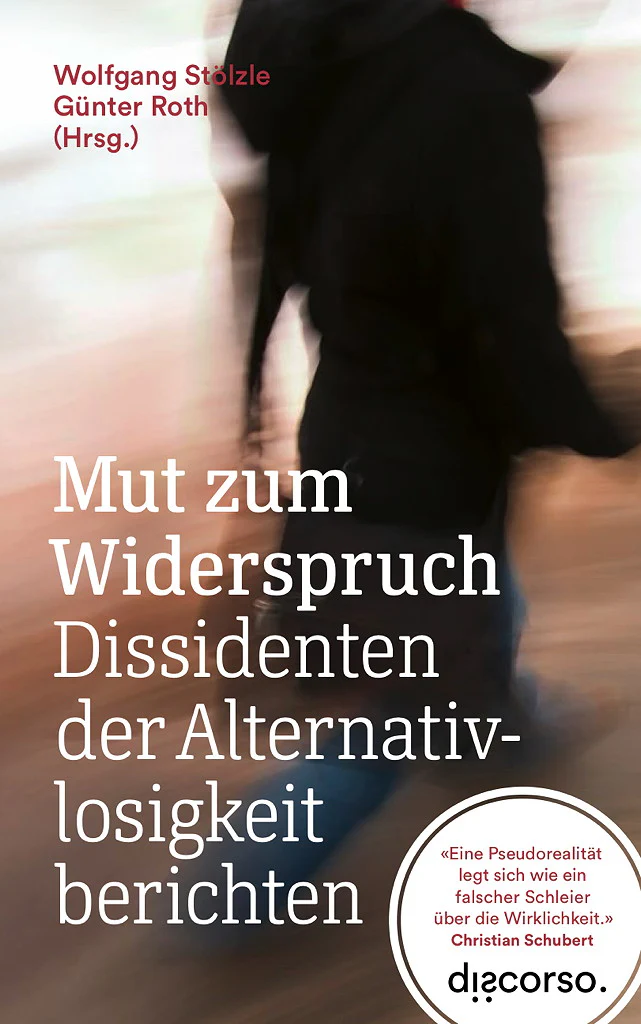
Last year, together with a few colleagues from the MWGFD, including Klaus Steger, Christian Schubert, Anne Ulrich, Stefan Hockertz and several others, I founded the Discorso publishing cooperative in Basel. Our website https://discorso.ch/ provides information about our goals and our books. The first book, ‘Courage to Disagree – Dissidents of the Lack of Alternatives Report’, edited by Wolfgang Stölzle and Günter Roth, will be published on 11 December and can now be pre-ordered on our website. The 400-page book summarizes the experiences of 18 authors. In addition to myself, these include authors from the MWGFD circles – Christian Schubert, Andreas Sönnichsen – and other public figures who have spoken out against abuses either during the coronavirus crisis or even before it. In some cases, they have had to face harsh consequences, such as Daniele Ganser and Alessandra Asteriti. Most of the chapters deal with reprimands from the coronavirus period, such as the reports by Ulrike Guérot, Michael Meyen, Andreas Heisler, Alexander Bittner, Christian Dettmar, Lucian and Martin Michaelis, Carola Kistel. Finally, the experiences of the editors Günter Roth and Wolfgang Stölzle. Heike Egner and Anke Uhlenwinkel summarize their social science study on this topic and their own experiences, and Michael Esfeld wrote the foreword.

It is an important documentation of structures of exclusion, which, although covering different areas, involved similar mechanisms. Above all, it is a contradiction to false factual claims and opinion manipulation. This volume shows that such contradiction is possible, but may come at a cost. Sometimes that cost is high. However, each contribution also shows that such supposed slaps in the face simultaneously open up new paths and therefore give cause for hope. At least, that was the intention of all the authors.

Readers of this book, which can be ordered for £29.80 (400 pages) on the Discorso website, where more detailed information is also available, should judge for themselves to what extent this has been achieved.

By the way: anyone who wants to support our work can become a member of the cooperative for a minimum contribution of CHF 500 (or a multiple thereof) and purchase one or more share certificates. This allows members to participate, help shape, assist or simply provide support. Anyone interested should contact me at hw@discorso.ch.

Read more

Book review Helmut Sterz: The Vaccination Mafia

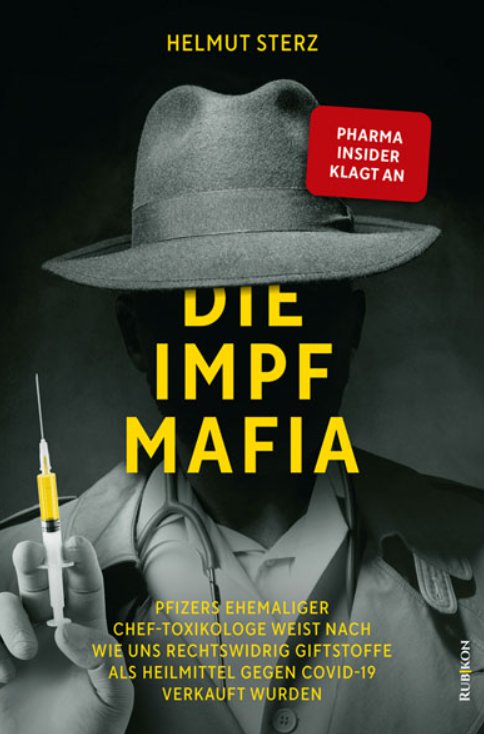
I have read Helmut Sterz’s new book and will discuss it briefly here. It will be published on 1 December and is the most important book on coronavirus awareness that I am aware of (though I haven’t read them all). I highly recommend it to the readers of my blog. The book is only available in German, but I still want to convey the most essential aspects with my discussion for my English language readers.

Helmut Sterz: Die Impf-Mafia (The Vaccine Mafia). Pfizer’s former chief toxicologist proves how toxic substances were illegally sold to us as a cure for Covid-19. Basel: Rubikon. 240 pages. £24, ISBN 978-3-907606-00-1

The most significant part of this book on the coronavirus comes at the very end, on pages 206–210: ‘Demands for the investigation of the global pharmaceutical scandal’. There, the author makes 18 demands. In my opinion, the following are particularly noteworthy (in my own words – where not indicated by quotations, which are literal translations from the book):

Read more

Only 14% of those with a positive PCR coronavirus test actually infected

Our new study proves that only 14% of those who suffered restrictions as ‘infected’ individuals with a positive PCR coronavirus test were actually infected.

During the unfortunate coronavirus years, we all had to endure nasal or throat swabs followed by PCR tests, sometimes on a daily basis, combined with anxious waiting: Is it positive? Will I now be unable to travel, go to work, university, restaurants or meeting places? Even the German Infection Protection Act stipulates this testing procedure. In our new study [1], recently published in Frontiers in Epidemiology, we show that only 14% of those who tested positive with a PCR test and therefore often had to experience some form of restriction actually had a manifest infection.

This can be deduced from a comparison of data collected with a PCR test and an IgG antibody test. The polymerase chain reaction (PCR), invented by Kary Mullis [2] in the 1980s, for which he received the Nobel Prize, uses tiny snippets of any gene sequence and searches for the matching counterpart in a sample. And if it finds even a single such counterpart, it amplifies it as often as desired and as long as the process is kept running. This works through cycles of repetitions. According to laboratory wisdom, I have been told by specialists, this is normally not done more than 20 times, because otherwise the risk of a false positive result becomes too great. One would then claim that a certain gene sequence was found in someone or in a sample, even though it is not actually there. This so-called cycle threshold, abbreviated CT, is therefore an essential part of a PCR test. This is because it provides information about how often the original sample must be amplified in order to find something. Can anyone remember a CT value being specified on the PCR test that was given to us? No? That’s right. Because it was almost never specified. However, we know from various studies that German laboratories worked thoroughly with CT values of 30 to 35, sometimes even up to 40 (evidence in our publication). Therefore, the risk of false positive results was very high.

Read more