Rabid Fact Foxes

The press is increasingly ceasing to be the ‘fourth estate’ and is instead becoming a court reporter, thereby acting as the gravedigger of democracy

In many of my blogs during the coronavirus pandemic, I have repeatedly asked, “Where are the investigative journalists?” “Where is the critical press?” With a few exceptions, I have noticed little critical reporting on official coronavirus policy, the ‘measures’, the state’s desire to force vaccinations on everyone, and related topics. The press has almost always sung from the same hymn sheet as the official statements from the government and its health related agencies. In my interview study, which I have so far only analysed in my coronavirus novel “Verschachtelte Wahrheit”, I also asked several media professionals why this is the case. The answers were complex, but one key element runs through them all:

The mental filter. There may well have been official directives from above at times, telling the editorial staff which way to go. But far more important is the “perceived truth”, what most people see as the “right” thing, what is politically correct, what people need to be taught. It is no longer what is actually the case that counts, but rather that one displays the correct attitude. And the correct stance is that of those perceived as progressive, liberal, left-wing—in short, the majority—and, coincidentally, it is also the stance of those in power. If you fail to toe this majority line, as a normal reporter or editor you run the risk of no longer being taken seriously, of no longer getting assignments, and perhaps even of losing your contract. The precarious world of short-term contracts and freelance work, which can be terminated at any time, has, according to my informants, largely replaced the once more common positions of editors and chief reporters who could not easily be sacked and were therefore steadfast in their views.

Read more

Nip It in The Bud – Prevent Compulsory Vaccination, Abolish The Measles Protection Act

The German Bundestag petition calling for a review of the Measles Protection Act is online

Anyone who hasn’t been asleep over the past few years will have noticed: the signs point to coercion and state paternalism. Everywhere. But especially in the healthcare sector. The SARS-CoV-2 pandemic was a vast funnel designed to drive the majority of people towards untested and, as we now know, dangerous genetic prevention technologies, which politicians euphemistically sold to us as ‘vaccinations’. The promises were all hollow, not to say outright lies. From Germany’s Merkel’s “The pandemic will be over once we have the vaccine” to Health Ministers’ Spahn and Lauterbach’s “effective and safe”.

During this pandemic, on 10 February 2020, a new Measles Protection Act was enacted, which came into force on 1 March 2020, conveniently at a time when nobody was really paying attention. The draft dates from September 2019, and anyone familiar with ministerial bureaucracy knows that something like this must have been hatched some time beforehand so that it could then be presented to parliament as a draft.

The core of this law is the requirement for nursery school children to provide proof of measles vaccination so that they can attend nursery school or a childcare centre. Immunity to measles can also be demonstrated by antibody titers, i.e., by the fact that a child has already had measles (see). As compulsory schooling takes precedence in Germany, checks may still be carried out and a missing vaccination certificate reported to the health authority, but the authorities are not permitted to prevent the child from attending school. Once compulsory schooling has ended, i.e., for secondary and further education, this may become an issue again.

In effect, therefore, the requirement to provide proof of a measles vaccination amounts to the introduction of a compulsory measles vaccination.

Read more

US Health Bureaucracy: Reorientation towards ‘Autoimmunity’

Admission of guilt by the American health bureaucracy regarding mistakes in coronavirus measures and reorientation towards ‘autoimmunity’

Personnel changes within the US health authorities have resulted in new priorities. Jay Bhattacharya has been director of the National Institutes of Health since 2025, the super-agency that conducts its own research and funds much of the research in the US through large programmes. In addition, Anthony Fauci was replaced by Jeffery Taubenberger as director of the National Institute of Allergy and Infectious Diseases (NIAID) after a brief interim period.

The coronavirus measures were wrong and have damaged the reputation of the NIH and science

In an editorial in Nature Medicine describing the new direction of this institute, Bhattacharya, Taubenberger and their co-author Powers now clearly distance themselves from basically everything that constituted pandemic management in the US and, as a result, almost the entire world [1].

The authors write:

“… many of the recommended policies, including lockdowns, social distancing, school closures, wearing masks and vaccine mandates, lacked robust confirmatory evidence and remain the subject of debate about their overall benefits and unintended consequences. Where enforced, vaccine mandates contributed to decreased public confidence in routine voluntary immunizations. We recognize that much of the American public lost trust in the NIAID, the National Institutes of Health (NIH; of which the NIAID is a part), and in the greater scientific community. As current leaders of the NIH and the NIAID, we acknowledge this breach of trust…”

Let us pause for a moment to consider these words. They describe nothing less than the acknowledgement that the core elements of the so-called ‘pandemic response’, i.e. the political response to the pandemic, were devoid of scientific basis.

Read more

Only 14% of those with a positive PCR coronavirus test actually infected

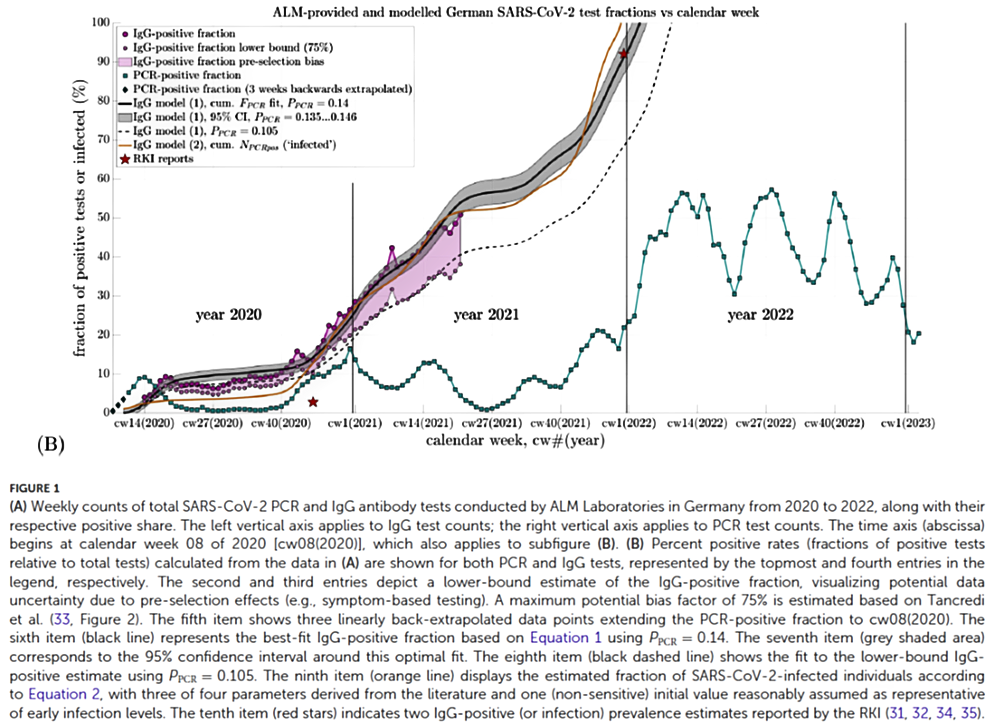
Our new study proves that only 14% of those who suffered restrictions as ‘infected’ individuals with a positive PCR coronavirus test were actually infected.

During the unfortunate coronavirus years, we all had to endure nasal or throat swabs followed by PCR tests, sometimes on a daily basis, combined with anxious waiting: Is it positive? Will I now be unable to travel, go to work, university, restaurants or meeting places? Even the German Infection Protection Act stipulates this testing procedure. In our new study [1], recently published in Frontiers in Epidemiology, we show that only 14% of those who tested positive with a PCR test and therefore often had to experience some form of restriction actually had a manifest infection.

This can be deduced from a comparison of data collected with a PCR test and an IgG antibody test. The polymerase chain reaction (PCR), invented by Kary Mullis [2] in the 1980s, for which he received the Nobel Prize, uses tiny snippets of any gene sequence and searches for the matching counterpart in a sample. And if it finds even a single such counterpart, it amplifies it as often as desired and as long as the process is kept running. This works through cycles of repetitions. According to laboratory wisdom, I have been told by specialists, this is normally not done more than 20 times, because otherwise the risk of a false positive result becomes too great. One would then claim that a certain gene sequence was found in someone or in a sample, even though it is not actually there. This so-called cycle threshold, abbreviated CT, is therefore an essential part of a PCR test. This is because it provides information about how often the original sample must be amplified in order to find something. Can anyone remember a CT value being specified on the PCR test that was given to us? No? That’s right. Because it was almost never specified. However, we know from various studies that German laboratories worked thoroughly with CT values of 30 to 35, sometimes even up to 40 (evidence in our publication). Therefore, the risk of false positive results was very high.

Read more

Scientific publication on the mismanagement of the COVID-19 crisis

The global, collective mismanagement of the COVID-19 crisis has now been clearly outlined and published in a scientific journal

Quinn, G. A., Connolly, R., ÓhAiseadha, C., Hynds, P., Bagus, P., Brown, R. B., . . . Walach, H. (2025). What Lessons can Be Learned from the Management of the COVID-19 Pandemic? International Journal of Public Health, 70, 1607727. doi:10.3389/ijph.2025.1607727; https://www.ssph-journal.org/journals/international-journal-of-public-health/articles/10.3389/ijph.2025.1607727/full

I have worked with 36 other authors on a detailed policy paper on the international collective mismanagement of the COVID-19 crisis, which has now been published and is available to the general public via the link above.

Some of these authors are well known, such as Robert Malone, Harvey Risch, Jessica Rose and Norman Fenton, while others have been less active in the public eye than in academia, such as Gerry Quinn, the lead author and organizer of the consortium, and others. One of the authors, Yaffa Shir-Raz from Haifa, has just published, together with others, a detailed critique of the claim that COVID-19 ‘vaccinations’ have saved millions of lives (Preprint; see also).

What they all have in common is that during the COVID-19 crisis, they argued extensively and with good scientific documentation that one or more aspects of the response to the crisis were not sufficiently scientifically sound or were even harmful. Whether it was masks, mandatory vaccination, social distancing rules, ‘vaccinations’ or other non-pharmaceutical measures (‘lockdown’).

Read more