
The press is increasingly ceasing to be the ‘fourth estate’ and is instead becoming a court reporter, thereby acting as the gravedigger of democracy
In many of my blogs during the coronavirus pandemic, I have repeatedly asked, “Where are the investigative journalists?” “Where is the critical press?” With a few exceptions, I have noticed little critical reporting on official coronavirus policy, the ‘measures’, the state’s desire to force vaccinations on everyone, and related topics. The press has almost always sung from the same hymn sheet as the official statements from the government and its health related agencies. In my interview study, which I have so far only analysed in my coronavirus novel “Verschachtelte Wahrheit”, I also asked several media professionals why this is the case. The answers were complex, but one key element runs through them all:
The mental filter. There may well have been official directives from above at times, telling the editorial staff which way to go. But far more important is the “perceived truth”, what most people see as the “right” thing, what is politically correct, what people need to be taught. It is no longer what is actually the case that counts, but rather that one displays the correct attitude. And the correct stance is that of those perceived as progressive, liberal, left-wing—in short, the majority—and, coincidentally, it is also the stance of those in power. If you fail to toe this majority line, as a normal reporter or editor you run the risk of no longer being taken seriously, of no longer getting assignments, and perhaps even of losing your contract. The precarious world of short-term contracts and freelance work, which can be terminated at any time, has, according to my informants, largely replaced the once more common positions of editors and chief reporters who could not easily be sacked and were therefore steadfast in their views.
This also explains why the press, as the ‘fourth estate’—as most democratic constitutions actually regard it—is already dead. When it comes to politically less controversial topics—the carbon footprint of cat food, how much tourism Mount Everest can sustain, that sort of thing—critical research and reporting take place. But the idea that the government might have made mistakes regarding COVID-19, the aggressive vaccination campaign, or lockdowns and measures—mistakes that are actionable in law and should lead to personnel, financial and political consequences—is taboo. Only the wild, alternative press writes about that. Not the good boys and girls in the mainstream media. Official Berlin is currently trying, via a cross-party expert commission on the COVID-19 measures, to paint a picture of just how brilliantly the government has acted. A few of my colleagues are active in this commission and in the state-level study commissions. That’s why I hear the odd soundbite or two. The gist: They’re trying to issue themselves a clean bill of health, claiming they did everything right.
It starts with the fact that there was no parliamentary inquiry committee, but rather a fact-finding commission. In an inquiry committee, those questioned are under a legal obligation to answer and tell the truth. The study commission issues recommendations and is a much gentler instrument.
Now the press, too, feels compelled to help the beleaguered government: “Fact-checkers” are rushing in to “verify” whether everything was above board. Whether those questioned told the “truth”. And seasoned experts are being belittled by journalists with little specialist knowledge.
I wish to illustrate this using my own experience from a few years ago and a recent case study. It concerns the ARD’s “fact-check” of our study on children’s face masks. The current example concerns a fact-check by a journalist from AFP (Agence France-Presse – the French press agency) regarding statements made by Helmut Sterz in the Bundestag’s Enquete Commission, claiming that the COVID-19 vaccinations had caused around 60,000 deaths. Regarding this case, my colleague Robert Rockenfeller had an interesting email exchange with a fact-checking journalist, which I reproduce in full below. It offers a glimpse into the inner workings of fact-checkers, particularly through the way in which my colleague’s reliable information was suppressed and, above all, how only ‘experts’ with views aligned with the government were given a voice.
An equestrian reporter strays into the fox hunt and becomes a “fact fox” – my experience with a fact-checker
I had reported on this before: When we published our study on children’s face masks, an outcry went through the scientific world. JAMA Pediatrics retracted our study [1]. We were able to republish the full version following a further, triple peer review [2], where it remained and is still available, despite further attacks [3]. This process alone shows that our data is sound and that, whilst the methodology may be open to criticism, it was factually correct. At the time, ARD—I felt honoured—called in a ‘fact fox’ (fact-checker). Apparently, all the good foxes were either in their dens or out hunting. So equestrian reporter Rohwedder had to step in. My fellow journalist Peter Bickel has just published a very precise, detailed and illuminating analysis of this incident on the MWGFD website. So I can keep it brief here and offer a few witticisms.
‘Fact fox’ Rohwedder was endowed with a brilliant expertise that virtually predestined him to be a fact-checker for scientific papers: he is, after all, an equestrian sports reporter by trade. This fact alone shows just how seriously our public service television takes fact-checking. Under the German public service media contract, public service broadcasting is obliged to conduct thorough research and provide balanced reporting. This makes it all the more embarrassing that the ‘fact-checker’ made some serious errors in his ‘check’. He wrote that our paper had not been peer-reviewed, since it was a Research Letter. A quick glance at the journal’s website would have shown him that all Research Letters are peer-reviewed. In our case, three peer reviewers plus the editor had reviewed the work. As an equine specialist, he naturally understands the complexity of carbon dioxide measurements better than our measurement specialist Helmut Traindl, who, as a court-sworn expert for indoor gas measurements, in his eyes would apparently have been better off opening a horse betting office than carrying out gas measurements.
It is therefore clear that the ‘fact-checker’ Rohwedder possessed the expertise to deem our measurement method unsuitable. It also escaped him that our method is the standard procedure for measuring carbon dioxide levels in horse stalls – excuse me, in incubators for infants. Anyone wishing to know more can consult Peter Bickel’s detailed analysis of a journalistic failure.
The essence of this affair: it is obvious that Tagesschau, or more precisely its editorial team, could only have had a single objective in pursuing such a course of action. Namely, to discredit me personally and to trivialise a controversial finding. Had it been taken seriously, it would have overturned the entire mask policy for children and possibly left those responsible legally vulnerable to charges of bodily harm. The aim, in plain terms, was therefore to act as an accomplice to a policy that disregards human dignity. In doing so, the public broadcaster has perverted a central duty of journalistic responsibility and has turned the criticism against those who criticised the prevailing policy—against us. However, we did not criticise with silly slogans and poor arguments. Rather, with clear, valid data. This is, so to speak, the dialectic of fact-checking. Twisting facts in such a way that only the examination of the distortion brings the truth to light. To put it another way: in the age of fact-checking, one can be fairly certain that whatever is being checked poses a threat to the prevailing narrative.
Fact-check of a journalistic report on Andreas Sönnichsen’s stance on compulsory measles vaccination on ARD
Peter Bickel has analysed a similar case based on an ARD television report by journalist Timo Robben, which I also recommend to my readers in its original form on the MWGFD website and will summarise only very briefly here. Andreas Sönnichsen was asked about his stance on the measles vaccination. I briefly summarised his position in my latest blog post on the measles vaccination. Andreas Sönnichsen argues on his website that the risk of suffering a serious side effect from a measles vaccination is 2,000 times higher than the lifetime risk of suffering a serious illness from the measles disease itself. He substantiates this calculation with data from the literature and official figures from the RKI (German health crisis response agency).
Therefore, he believes, and I agree with him, any measles vaccination is actually contraindicated at the moment, because a key element for an indication is missing: namely, the benefits outweighing the risks. If the risk outweighs the benefit, current medical ethics dictate that an intervention should not be carried out. The interesting thing about the television report, according to Peter Bickel, is that it employs framing, manipulation and, above all, the omission of important information. This pattern is frequently encountered. Journalists are, after all, adept at protecting themselves against criticism. So they do not necessarily say anything false. But the omission of crucial information—in this case, information that is both important and exculpatory—is also a subtle form of lying.
Admittedly not an active lie, but a passive one. An author who spreads such a passive lie could always argue: ‘I didn’t know that’ or ‘He didn’t tell me that’ or ‘I didn’t think that was important.’ In this case, it is clear that none of this counts as an excuse. We spoke to Andreas Sönnichsen and know: he stated it clearly and unequivocally. But the journalist actively suppressed this information. Why, one wonders? He either had a clear mandate or the intention to portray Andreas Sönnichsen, the former professor of general medicine at the University of Vienna and former head of the Evidence-Based Medicine network in Germany, as a somewhat dim-witted simpleton, trapped in his conspiracy theory ideology and threatening children’s and public health.
We see it again: journalism, in this case public service journalism, is failing to fulfil its duty to provide balanced information and neutral reporting. It is not even interested in the facts, let alone the truth. It is interested in only one thing: further propagating the official narrative. This is commonly known as: propaganda.
And now for our
peek into the engine room: real-time fact-checking – a current example
Those were all more or less recent examples. Now here is a very recent example. I’d like to briefly explain the background:
Some of my readers are already familiar with Dr Helmut Sterz. I had reviewed his book ‘Die Impfmafia’. Sterz was the long-standing chief toxicologist at Pfizer Europe and, in this role, was responsible for the toxicological testing of new drugs prior to their approval. He had to prepare the toxicological dossiers for his employers, which are required by the regulatory authorities when new medicines are to be approved. He is, therefore, an absolute expert. With the book “Die Impfmafia” [4], he has spoken out because he found the gross errors in the approval of the COVID-19 mRNA vaccines intolerable. In the book, he wrote that it had long been standard practice that, if more than one death per million vaccine or drug doses was documented in pharmacovigilance data, a safety signal would be triggered and the drug or vaccine would be withdrawn. According to Sterz, this signal had already been reached by early 2021 and should have led to the recall of the COVID-19 vaccines. In his book, he dismantles the toxicology studies carried out as inadequate and highlights the regulatory failure, which in this case lies with the Paul Ehrlich Institute and the European Medicines Agency. Incidentally, the drastic wave of redundancies at BioNTech and the slump in its share price seem to prove him right.
In this capacity, Sterz was invited to join the Bundestag’s Enquete Commission as an expert, having been nominated by the AfD. There he stated that the figure of around 2,000 deaths cited by the PEI must be multiplied by 30 to arrive at the likely true number of fatalities attributable to these vaccines, i.e. approximately 60,000 deaths. This figure went viral and was disseminated by various activists, YouTubers and X accounts, particularly by a Swedish activist with a right-wing political slant who appears to have a wide reach. At least, that is what a fact-checker from Agence France-Presse (AFP) reported. It is worth taking a look at their article first before reading on. Interestingly, it is only available in German, perhaps because it is primarily aimed at a German readership.
I came across this because my colleagues Robert Rockenfeller, a mathematician at the University of Koblenz, and Michael Günther, a physicist at the University of Stuttgart, forwarded the correspondence with the agency to me. Both had published a very interesting study on this question in a different context [5]. Using carefully processed and standardised mortality data from Germany over the last 24 years, they calculated mortality rates in age cohorts. They were then able to calculate expected mortality and excess mortality, broken down by calendar week. Finally, they calculated time-lagged correlations between these time series and the time series for vaccinations and PCR testing. A time-lagged correlation can be used to test a causal hypothesis. Since the cause must always precede the effect, if a higher correlation is observed at an earlier point in time, one can assume that the preceding time series, in this case, for example, vaccination or testing for a specific variant, may have been the cause of the excess mortality. This was indeed the case, particularly for the age cohorts between 30 and 39 and between 60 and 80 years. Above all, the interaction between a positive test result and vaccination was also clearly correlated with excess mortality with a significant time lag. This can be interpreted as a higher susceptibility to a new variant of the pathogen caused by the vaccination. Anyone wishing to know more should read up on it. I mention this here as background.

Because this is where the story begins. So, on 20 April 2026, Ms Fact Fox wrote a friendly email to Robert Rockenfeller, which I am reproducing here:
Dear Dr Rockenfeller,
I hope you’re well. I’m getting in touch from the news agency AFP’s fact-checking service for Finland and Sweden, where we investigate mis- and disinformation circulating online. The aim is to debunk potentially harmful claims and to stop them from spreading further.
I’m looking into claims made during a hearing of the German parliamentary enquiry commission looking into the Covid pandemic in March. According to the claims, made by Dr Helmut Sterz, Covid vaccines, and Comirnaty in particular, have resulted in 20,000-60,000 deaths in Germany. The claims have now gone viral in the Nordic countries after a Swedish far-right activist shared them on X.
I came across your work looking at mortality, and I was wondering if you might be available to comment briefly on a couple of questions for the fact-check article (for attribution) on mortality calculations, or if you have another expert in mind? Over email would work well, or I’d be happy to arrange a call, if that would be better. I’m hoping to have answers by the end of the week, although my deadline is flexible.
My questions are:
- The first claim is that between 20,000 and 60,000 deaths in Germany have been caused by the vaccine Comirnaty. Are you aware of any research showing a peak in mortality caused by Covid vaccines in Germany?
- Your study last year in PLOS ONE showed that mortality increased after the start of the Covid vaccination campaign, rather than directly after the start of the pandemic. How large was the increase? And is there any evidence for a causal connection?
- The second part of the claim is that in order to address underreporting, in the US one uses an “underreporting factor of 30”, by which registered cases have to be multiplied. Dr Sterz applies this to the number of reported deaths following Comirnaty (2,133) he says the Paul-Ehrlich-Institut has received. This is how he arrives at 60,000 deaths caused by the vaccination. Is the “underreporting factor of 30” an actual method to take into account unreported cases? How is underreporting taken into account when looking mortality?
The fact check would initially be published on our Finnish website here: https://faktantarkistus.afp.com/. We may also publish it in other languages and on other platforms (for example, as part of European fact-checking projects).
Any help would be much appreciated, and I’m of course happy to answer any questions you may have.
Best wishes,
Anna Hollingsworth
Fact-checking journalist
Agence France Presse
So far, so good: a polite request for sources and data. My colleague Robert Rockenfeller replied promptly, on 20 April 2026, with a detailed response:
Dear Anna,
Thank you very much for joining this discussion.
Regarding your questions, I would like to provide some details and my assessment, based on the research findings of our own group.
The first claim is that between 20,000 and 60,000 deaths in Germany were caused by the Comirnaty vaccine. Are you aware of any research findings that demonstrate an increase in mortality in Germany caused by Covid vaccines?
We may first need to agree on the terminology, as this is indeed crucial. On the one hand, there is a temporal association (cross-correlation) between the administration of vaccines and mortality; on the other hand, the issue concerns deaths that were ‘caused by’ the vaccine, e.g. as determined by a thorough autopsy.
As regards the former (the correlation), there are several studies that do indeed show a high correlation between the administration of the mRNA vaccine against SARS-CoV-2 and excess mortality in Germany. Some examples of this include (among others)
- Our own study in PLOS ONE (https://doi.org/10.1371/journal.pone.0334884), which I will return to later
- Several studies by the team led by Matthias Reitzner and Christof Kuhbandner, e.g. in Royal Society Open Science (https://doi.org/10.1098/rsos.250790), in which a spatial (as well as temporal) correlation was even observed.
- A similar finding from a medical perspective in the European Society of Medicine: https://doi.org/10.18103/mra.v13i9.6883
As regards the latter (causality), I refer you to the second part of your next question.
Your study from last year in PLOS ONE showed that mortality rose after the start of the Covid vaccination campaign, and not immediately after the start of the pandemic. How high was the increase?
Here, too, caution is required in the wording: it is to be expected in any case that ‘mortality’ in Germany will rise due to demographic change. However, if mortality turns out to be even higher than expected beyond demographic changes, we refer to this as ‘excess mortality’ (EM). Depending on the underlying assumptions, you will find many estimates of EM. In an earlier article (https://doi.org/10.1098/rsos.221551), we refuted the WHO’s estimate, which was fundamentally flawed (see in particular Appendix C).
To provide a better overview of these various estimates, we recently published a preprint (https://zenodo.org/records/18487594), in which I would like to draw your attention to Figure 21. Here – if you look at the green squares – you can see that mortality in 2020 was essentially in line with expectations. No more and no fewer people died than expected; in other words, there is no evidence of a pandemic. In 2021, you can see a sudden rise in excess mortality to around 20,000 to 40,000, whilst in 2022 it is even higher, at around 60,000 and above! By 2023 and 2024, it is almost back to normal.
And is there evidence of a causal link?
I could now launch into a very long monologue about how I generally believe that medicine rarely has convincing evidence of a ‘causal link’, as it usually involves correlations (see above).
Nevertheless, one could envisage two ways of determining something that comes quite close to a causal link:
1) Formulate and test an immunological hypothesis.
We have at least formulated one (and are really urging people to test it) in our PLOS ONE article (see section 4.1 of the discussion there)
2) Try to rule out other possibilities.
A few years ago, we published an estimate of the number of deaths causally linked to the vaccine (https://doi.org/10.56098/s9cjk650).
See in particular Fig. 1. Therefore, we did not simply extrapolate the death figures, but first cross-referenced the Paul Ehrlich Institute’s (PEI) passive reporting system with data from German insurance companies. We found an under-reporting factor of about 10, which is very conservative compared to other countries. However, from this 10-fold figure for deaths, we subtracted those where death was to be expected from all causes. In the end, this resulted in a difference of about 17,000 people … in Germany alone in 2021. Even taking autopsy results into account – and making a further downward adjustment to the figures – we arrived at a figure of more than 11,000 people for whom we would almost certainly speak of ‘causal links’.
The second part of the claim is that, in the US, to account for under-reporting, a ‘under-reporting factor of 30’ is used, by which the recorded cases must be multiplied. Dr Sterz applies this to the number of reported deaths following Comirnaty (2,133), which the Paul Ehrlich Institute received, according to his information. This leads him to a figure of 60,000 deaths caused by the vaccine. Is the “underreporting factor of 30” a valid method for accounting for unreported cases? How is under-reporting taken into account when considering mortality?
The PEI itself acknowledges an under-reporting factor of 10–20 for serious or fatal adverse events (see here on page 30: https://www.pei.de/ SharedDocs/Downloads/DE/newsroom/bulletin-arzneimittelsicherheit/2017/1-2017.pdf?__blob=publicationFile&v=2).
I do not personally know the exact source from which Prof. Sterz derived the factor of 30, but I assume he was referring to the US reporting system. I am unable to judge whether this is accurate.
However, given the factor of 10 to 20 cited by the PEI and our own findings, I would say that around 20,000 deaths for the year 2021 are entirely realistic, a figure that would certainly rise further when aggregated over several years. (Note: This concerns estimates of deaths caused by the vaccine in a single year, namely 2021. Dr Sterz spoke of all deaths over three years. 20,000 × 3 = 60,000)
Another question I would like to ask is as follows: Was there a safety signal indicating that mRNA vaccines were more dangerous/lethal than conventional vaccines?
On this point, I would like to refer once again to the PEI database, which shows that the reported deaths per 1 million vaccinations for non-Covid vaccines in the period 2003–2023 stood at around 0.6.
For mRNA vaccines, this rate rose dramatically from 2021 to a staggering 18, i.e. almost 30 times – deaths per million – and remained at 14 (more than 20 times higher) over the three-year period 2021–2023. Take a look at the graphical comparison here (unfortunately it is only available in German, but I don’t think that poses a major problem): https://www.barucker.press/p/pei-todesfalle-corona-impfung
How could this signal have been ignored?
I hope I have answered your main questions; should you have any further queries, please do let me know.
I would also be keen to read your article once you have finally published it.
Kind regards from Germany
Robert
———————————— ——————
PD Dr Robert Rockenfeller
Institute of Mathematics
Faculty of Mathematics and Natural Sciences
University of Koblenz
This, then, is the detailed and precise reply from my colleague, to which the journalist responds with a friendly thank you:
Dear Robert,
thank you very much for your prompt reply! That is extremely helpful and clearly worded—but I will get in touch if any further questions arise later.
Thank you very much!
Kind regards,
Anna
If you haven’t read the resulting article yet, do so now so that you can understand Robert Rockenfeller’s response dated 30 April 2024, which I reproduce below. A quick fact-check on the fact-check: The journalist also mentions Stefan Homburg and claims he is an AfD (German right-wing political party) member. That is definitely incorrect. I asked Mr Homburg. And one more small remark for those who haven’t read the article, or have only skimmed it: The article does not cite a single scientific source, but only expert opinions that confirm the official narrative, or government sources, and of course nothing of what Rockenfeller had written above. It is therefore understandable that he writes:
Dear Anna,
I have now read your published article (https://faktencheck.afp.com/doc.afp.com. A9777ZT) and must say that I am deeply disappointed by the way my contribution has been handled.
You expressly asked me for a scientific assessment, and I took the time to provide you with a detailed, evidence-based response, including references to peer-reviewed works, methodological distinctions (correlation vs. causality) and concrete numerical estimates based on data analyses. Yet none of these arguments appear to have been meaningfully (or at all) taken into account in your article.
This is not a matter of differences of opinion—differences of opinion would be entirely legitimate. What I see instead is omission.
Key aspects that you have deliberately ignored include:
- The documented temporal and spatial correlations between vaccination campaigns and excess mortality discussed in numerous studies
- The distinction between excess mortality and crude mortality, which is central to any serious analysis
- The methodological critique of widely cited estimates (including those from major institutions or the fraudulent French study)
- The quantitative analysis of under-reporting based on comparisons between reporting systems and insurance data
- The signal in adverse event reporting rates compared to historical baseline figures or previous vaccination campaigns
Instead, the article gives the impression that these claims exist in a vacuum, without acknowledging that there are published works—whether one agrees with them or not—that attempt to substantiate them.
From a scientific perspective, relevant data and arguments do not disappear simply because they are ignored. From a journalistic perspective, this raises serious concerns. Credible fact-checking must not consist of selectively citing sources that fit a predetermined narrative, whilst omitting dissenting analyses that were explicitly requested.
Had it been your intention to challenge or refute my arguments, I would have welcomed that. But to do so, one must engage with them rather than sidestep them.
I therefore ask you for clarification:
- Why were none of the cited studies or arguments included or critically discussed?
- On what basis were they deemed irrelevant or insufficient?
- How do you define ‘fact-checking’ if not as a process that involves evaluating competing interpretations of data?
At present, the article neither reflects our exchange nor does it correspond to my idea of a fair representation of the scientific discussion.
I would appreciate a well-founded response.
Yours faithfully,
Robert
——————————————————
PD Dr Robert Rockenfeller
Institute of Mathematics
Faculty of Mathematics and Natural Sciences
University of Koblenz
And what does Ms Fact Fox say on 4 May 2026?
Dear Robert,
Thank you very much for your message and the points you have raised. Please accept our apologies for the delayed response—we wished to examine this matter thoroughly first.
During the research phase for an article, we routinely consult more sources than we are ultimately able to cite. Our research process involves extensive background analysis and expert opinions. In this case, following our standard review process and our assessment of the general expert consensus, we decided not to include your analysis in the final article. This is a standard part of our journalistic work and editorial decision-making. Nevertheless, we very much appreciate you taking the time to respond to our original enquiry.
Kind regards,
Anna
Well, that’s friendly, clear and to the point, isn’t it? In plain language: After all, we have to ask the other side too. It’s part of our bloody journalistic duty. Whether we then quote that side is, unfortunately, not up to me, but to the bosses, and they found this part of the research irrelevant to what we wanted to say.
The point of contention—how does Sterz arrive at the factor of 30 to determine the number of deaths attributable to the vaccination?—is refuted solely by the objections of ‘friendly’ experts (‘that’s not the case’), but by not a single scientific source. And official statements are cited as evidence, even though their very uselessness is precisely the issue at hand. Sterz wasn’t asked. I asked him for the source. He wrote: “The figure of 30 for the URF comes from the Q&A section of ‘open VAERS’. A paper by Jessica Rose is cited there.” You see, it is important to know that the Enquete members have very little time for their statements before the commission and must weigh every word. They cannot elaborate further on their arguments, nor can they present overly complex arguments. So I shall now help dear Anna and everyone who finds the factor of 30 implausible:
As we have already seen above: even if one does not use the factor of 30, but instead the conservative excess mortality figures calculated by Rockenfeller and Günther—for which there is no better hypothesis than that they are linked to the vaccination campaign—we still end up with around 60,000 deaths over three years. I have already cited some literature in my blog post analysing the PEI data. There is a whole series of such studies. A 2006 review by Hazell and Shakri of 37 studies examining such underreporting found a median of 95% ‘underreporting’—i.e., missing entries for actual side effects—in the FDA database [6]. In other words: out of 100 side effects, only 5 are recorded in passive pharmacovigilance. This is the factor of 20 that Rockenfeller referred to: in reality, there are 20 times as many side effects as are recorded in pharmacovigilance.
There are other studies on this topic: Alatawi and Hansen [7] found that for statins, only 0.01% to 40% of side effects appear in the FDA’s pharmacovigilance database, and for biologics, 20–33%. Moore and Bennett [8] calculated a reporting rate for serious hemorrhagic side effects of 0.9% to 1.07% and, for venous thrombosis associated with thalidomide, a 9-year reporting rate of 2.3%.
In summary: the older review study by Hazell and Shakri cites 95% underreporting from 37 earlier studies: a factor of 20. Sterz’s factor of 30 would imply that an underreporting rate of around 3.3% is realistic. Looking at the figures from the more recent studies above, it is easy to see that this is likely to be a robust median estimate, at least not a far-fetched outlier. Even if Sterz had made a slip of the tongue and meant the factor of 20 derived from the review study, this factor, multiplied by the 1,445 deaths in the PEI database up to March 2023, which I have analysed and which do not represent the entire database, 28,900 deaths, or 42,660 based on the 2,133 deaths mentioned above. Is it not already clear from these figures that there are more than enough deaths?
In the CDC’s VAERS (Vaccine Adverse Event Reporting System) database, the situation looks like this:
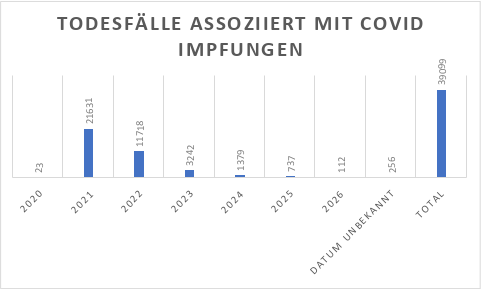
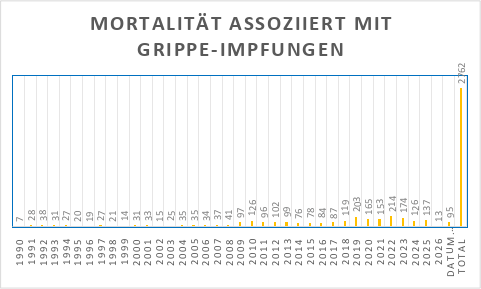
As of 7 May 2026, a total of 39,099 deaths related to COVID-19 vaccinations are recorded there. This data comes primarily from the US, although other countries can also submit data.
If we look at Figure 2: This shows all deaths recorded in the VAERS database since flu vaccinations have been available that are associated with all possible flu vaccinations. In total, there have been 2,762 such deaths since 1990. Flu vaccinations are relatively widespread. Unfortunately, the VAERS database does not provide information on the number of doses. But one might consider: at least as many people as have received the COVID-19 vaccines have also received flu vaccines over the years, especially as these usually need to be repeated. Nevertheless, the number of deaths associated with flu vaccines is more than ten times lower. And as mentioned: these are passive pharmacovigilance data, where one must expect at least 95% of data to be missing.
Can all these deaths be causally attributed to the vaccinations? Only indirectly, if one has other data suggesting a causal link, or in individual cases through autopsy. Rockenfeller cited studies suggesting such a causal link in his response. None of this appears in the article by our fact-checker Anna
So, third example: the press serves the ruling narrative. After all, that’s their job, isn’t it? That’s what they’re paid for by the taxpayer, or rather the consumer. The ‘fourth estate’ is dead. It has been for a long time. Only now are we finally realising it. I wonder if it has realised it itself?
References
- Walach H, Weikl R, Prentice J, Diemer A, Traindl H, Kappes A, et al. Retracted: Experimental assessment of carbon dioxide content in inhaled air with or without face masks in healthy children: A randomized clinical trial. JAMA Pediatrics. 2021. doi: 10.1001/jamapediatrics.2021.2659.
- Walach H, Traindl H, Prentice J, Weikl R, Diemer A, Kappes A, et al. Carbon dioxide rises beyond acceptable safety levels in children under nose and mouth covering: Results of an experimental measurement study in healthy children. Environmental Research. 2022;212:113564. doi: https://doi.org/10.1016/j.envres.2022.113564.
- Walach H, Traindl H, Prentice J, Weikl R, Diemer A, Kappes A, et al. Reply to Commentaries-„Is mask wearing hazardous for children? No the evidence is insufficient.” by Kenzo Takahashi and Tetsuya Tanimoto & comments by Patrick Steinle and Michael F. Koller. Environmental Research. 2023:115528. doi: https://doi.org/10.1016/j.envres.2023.115528.
- Sterz H. Die Impfmafia: Pfizers ehemaliger Cheftoxikologe weist nach, wie uns rechtswidrig Giftstoffe als Heilmittel gegen Covid-19 verkauft wurden. Basel: Rubikon; 2025.
- Rockenfeller R, Günther M. Cohort-resolved excess mortality in Germany (2000-2024): Patterns and implications for the SARS-CoV-2 era. PLOS ONE. 2025;20(10):e0334884. doi: https://doi.org/10.1371/journal.pone.0334884.
- Hazell L, Shakri SAW. Under-reporting of adverse drug reactions. A systematic review. Drug Safety. 2006;29(5):385-96.
- Alatawi YM, Hansen RA. Empirical estimation of under-reporting in the U.S. Food and Drug Administration Adverse Event Reporting System (FAERS). Expert Opinion on Drug Safety. 2017;16(7):761-7. doi: https://doi.org/10.1080/14740338.2017.1323867.
- Moore TJ, Bennett CL. Underreporting of Hemorrhagic and Thrombotic Complications of Pharmaceuticals to the U.S. Food and Drug Administration: Empirical Findings for Warfarin, Clopidogrel, Ticlopidine, and Thalidomide from the Southern Network on Adverse Reactions (SONAR). Semin Thromb Hemost. 2012;38(08):905-7. Epub 21.10.2012.