Discorso: ‘Opposing Mainstream Opinion – Dissidents of the New Normal Report’

Discorso publishing cooperative launches its first book, ‘Opposing Mainstream Opinion – Dissidents of the New Normal Report’

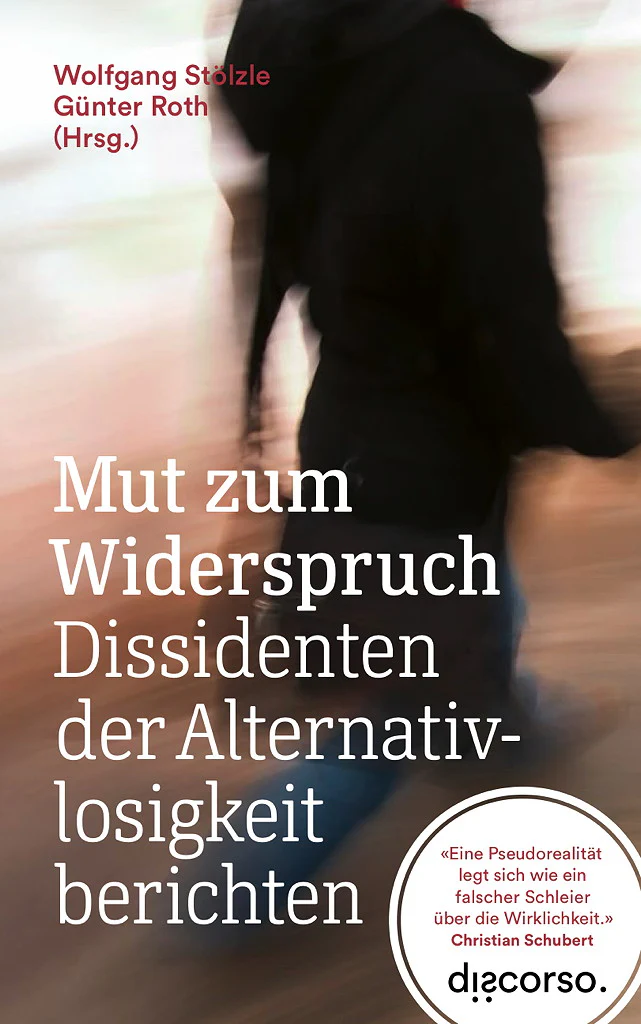
Last year, together with a few colleagues from the MWGFD, including Klaus Steger, Christian Schubert, Anne Ulrich, Stefan Hockertz and several others, I founded the Discorso publishing cooperative in Basel. Our website https://discorso.ch/ provides information about our goals and our books. The first book, ‘Courage to Disagree – Dissidents of the Lack of Alternatives Report’, edited by Wolfgang Stölzle and Günter Roth, will be published on 11 December and can now be pre-ordered on our website. The 400-page book summarizes the experiences of 18 authors. In addition to myself, these include authors from the MWGFD circles – Christian Schubert, Andreas Sönnichsen – and other public figures who have spoken out against abuses either during the coronavirus crisis or even before it. In some cases, they have had to face harsh consequences, such as Daniele Ganser and Alessandra Asteriti. Most of the chapters deal with reprimands from the coronavirus period, such as the reports by Ulrike Guérot, Michael Meyen, Andreas Heisler, Alexander Bittner, Christian Dettmar, Lucian and Martin Michaelis, Carola Kistel. Finally, the experiences of the editors Günter Roth and Wolfgang Stölzle. Heike Egner and Anke Uhlenwinkel summarize their social science study on this topic and their own experiences, and Michael Esfeld wrote the foreword.

It is an important documentation of structures of exclusion, which, although covering different areas, involved similar mechanisms. Above all, it is a contradiction to false factual claims and opinion manipulation. This volume shows that such contradiction is possible, but may come at a cost. Sometimes that cost is high. However, each contribution also shows that such supposed slaps in the face simultaneously open up new paths and therefore give cause for hope. At least, that was the intention of all the authors.

Readers of this book, which can be ordered for £29.80 (400 pages) on the Discorso website, where more detailed information is also available, should judge for themselves to what extent this has been achieved.

By the way: anyone who wants to support our work can become a member of the cooperative for a minimum contribution of CHF 500 (or a multiple thereof) and purchase one or more share certificates. This allows members to participate, help shape, assist or simply provide support. Anyone interested should contact me at hw@discorso.ch.

Read more

Book review Helmut Sterz: The Vaccination Mafia

I have read Helmut Sterz’s new book and will discuss it briefly here. It will be published on 1 December and is the most important book on coronavirus awareness that I am aware of (though I haven’t read them all). I highly recommend it to the readers of my blog. The book is only available in German, but I still want to convey the most essential aspects with my discussion for my English language readers.

Helmut Sterz: Die Impf-Mafia (The Vaccine Mafia). Pfizer’s former chief toxicologist proves how toxic substances were illegally sold to us as a cure for Covid-19. Basel: Rubikon. 240 pages. £24, ISBN 978-3-907606-00-1

The most significant part of this book on the coronavirus comes at the very end, on pages 206–210: ‘Demands for the investigation of the global pharmaceutical scandal’. There, the author makes 18 demands. In my opinion, the following are particularly noteworthy (in my own words – where not indicated by quotations, which are literal translations from the book):

Read more

On the roller coaster from a postmodern, welfare-state society to freedom – A book review

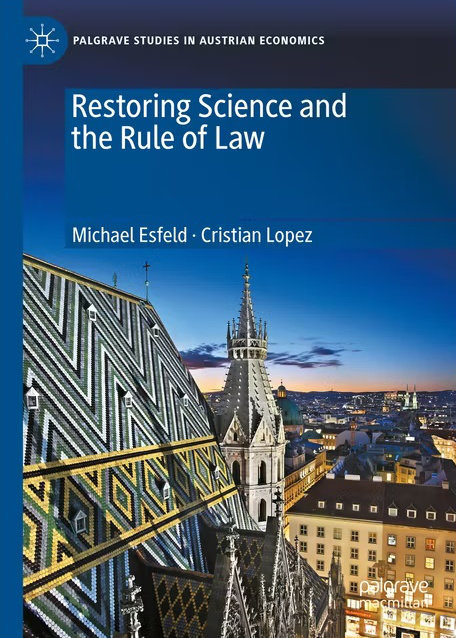
Michael Esfeld & Cristian Lopez: Restoring Science and the Rule of Law. Cham: Palgrave-macmillan/Springer. Palgrave Studies in Austrian Economics. 216 Seiten; CHF 142,00, eBook 114,00 CHF; ISBN 978-3-031-71185-5

Michael Esfeld is professor of science studies and the history of science with Lausanne University and the Swiss Technical University (EPFL) at Lausanne in Switzerland. He gained some fame, when he criticized the president of the time-honored academy Leopoldina, after it had produced a consensus statement backing the German government’s corona regime. He thought this was scientific bogus, and said so publicly.

I have met him at various occasions, interviewed him and had some very fruitful discussions with him. Otherwise, I have no conflict of interest. His postdoc Cristian Lopez works with him in Lausanne. Together they have authored this thought-provoking book, which sends the reader on a roller-coaster ride.

On roller coasters, you suddenly plunge into the depths and think you are going to hit the ground before a sharp curve takes you back up. Then you feel the sharp wind, look down anxiously, until you finally end up through several curves, mountains and valleys where you knew you had to end up from the beginning. Only now you are richer by your experience. Reading this book is a bit like that. Its message can be summarized briefly, and the rollercoaster ride is ultimately its argumentative development over several stages.

The message is this:

Since the Enlightenment, science, especially natural science, has become a motor of liberation. At the same time, it has contributed to the replacement of absolutist political structures by republican-democratic ones, and thus the rule of law has been established. This is not to be confused with the political rule of a state. But now this very success of science has turned to the fact that, on the one hand, the state has become more and more powerful and now demands a mediator, regulator and guide. Science must now serve this purpose. On the other hand, science, especially in the public perception, has become so entrenched that it has degenerated into scientism, into a belief in science. This threatens both concerns of the Enlightenment, namely, the liberation of man from the constraints of nature through good science and a liberal political structure. For the political structures have crippled themselves into a welfare state that exercises more and more domination and restricts more and more freedom. To justify this, it calls a warped science into the arena of political struggles to fight for it. Scientific scientism and political dirigisme thus go hand in hand. For reason and freedom fall by the wayside in both domains. And where reason is no longer the measure of research and action, ideologies take hold. Then a pseudoscience is used to justify a political agenda. Both support each other, and the whole thing ends in the forced beneficence of the modern welfare state. What is needed, therefore, is a new, proper Enlightenment that breaks open the narrowing of the first Enlightenment, removes the crippling of political structures, and thus liberates both science and society and, with it, economic forces.

This can be achieved by limiting science to its core competence. This is exclusively committed to the objective description of reality through perpetual critical discourse and critique of positive findings. It cannot and must not be used to justify political narratives because that contradicts its essence. After all, science never has a final answer, but only provisionally valid ones. Science by consensus, as it is increasingly being claimed in various subject areas, is always a self-contradiction. If science is left free from political paternalism, then science provides very useful insights, the utilization of which is then determined in a free society by free citizens who know how to use their own minds and are engaged in free discourse and exchange of goods. Furthermore, it is important to limit the community again to what it was intended for by the Enlightenment: as an institution that, through the rule of law, defines above all defensive rights. These are negative rights, in the face of an intrusive state and greedy neighbors. In such a view, positive rights, on the other hand, have little or nothing to do with it. Positive rights are those that the state takes upon itself to regulate coexistence beyond what is necessary, e.g. the right to collect taxes to finance state tasks and to redistribute wealth. Ultimately, the model proposed by Esfeld and Lopez amounts to an anarchistic solution to the Hobbesian dilemma.

Read more

A middle way in difficult times

Sailing between the Scylla of gullibility and the Charybdis of conspiracy theories in the Corona crisis

Thoughts on Mattias Desmet’s new book, The Psychology of Totalitarianism (London: Chelsea Green, 2022, 231 pages, €32.50, hardcover)

In the corona crisis, one sees two main camps: those who largely believe the mainstream narrative of the coronavirus to be true, and those who question this narrative – sometimes loudly, sometimes quietly. The first group, for the sake of simplicity, I will call below the believers, the others the doubters.

The doubters usually have one major problem: namely, understanding how it is possible that so many of their – quite intelligent – contemporaries subscribe to such an obviously false narrative that the believers believe to be true. I locate myself among this group of doubters. Many in this group then look for explanations and very often end up with one or another conspiracy narrative. Such a conspiracy narrative then explains that some group – the pharmaceutical industry, the financial industry, sinister groups in the backrooms of politics, a Satanist gang, the World Economic Forum (WEF), a secret world government, the “elites” – instigated the whole thing to further their own agenda. I can well understand why people seek such theories as explanations and often find them plausible, but I personally find them rather inadequate as explanations most of the time.

Read more